&w=3840&q=80)

Dependency Inversion is a software design principle that helps create loosely coupled systems. Formally, it means high-level modules should not depend on low-level modules; both should depend on abstractions.
In practice, this inverts the usual dependency structure: the source code dependencies point in the opposite direction of the flow of control.
To understand this, we need to clarify two concepts: control flow and dependency direction:
- Control Flow: The runtime execution path of a program – which functions or components call others as the app runs. For example, a parent component rendering a child, or a function calling a helper function, represents control flowing from the parent to the child or from the caller to the callee.
- Dependency Direction: The compile-time relationships between modules – which module knows about or imports the other. In traditional code, if component A calls function B, then A depends on B (A must import or instantiate B). The dependency direction usually aligns with control flow.
In Dependency Inversion, these two directions don’t align.
In the left diagram (Figure 1), Object A (high-level) directly references Object B (low-level), so A depends on B.
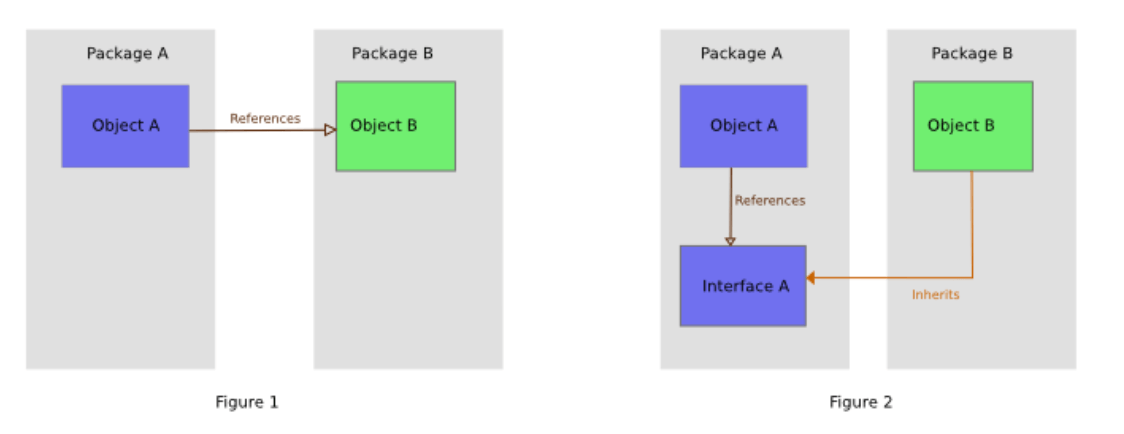
In the right diagram (Figure 2), an Interface A is introduced; Object A depends on Interface A, and Object B implements Interface A. The dependency arrows (brown) now go opposite to the runtime call direction, inverting the dependency.
Examples in React.js
Let’s examine how Dependency Inversion applies to React components. We will compare a simple component architecture without Dependency Inversion and then with Dependency Inversion, to see how the flow and dependency structure change.
Without Dependency Inversion: The component depends on a specific API (/api/user) and the way it is called (via fetch). It is not possible to use a different data source without rewriting the component. It is also not possible to reuse the component with a different user type (for example, administrator).
import { useEffect, useState } from "react";

const UserProfile = () => {

  const [user, setUser] = useState(null);

  useEffect(() => {

    fetch("/api/user")

      .then(res => res.json())

      .then(setUser);

  }, []);

  if (!user) return <div>Loading...</div>;

  return <div>Hello, {user.name}</div>;

};
With Dependency Inversion: The component knows nothing about the way the data is loaded. You can easily pass a mock function when testing. You can use the component in different places with different loading logic (fetch, axios, local storage, GraphQL, etc.).:
import { useEffect, useState } from "react";

// Component receives a function as a dependency

const UserProfile = ({ loadUser }) => {

  const [user, setUser] = useState(null);

  useEffect(() => {

    loadUser().then(setUser);

  }, [loadUser]);

  if (!user) return <div>Loading...</div>;

  return <div>Hello, {user.name}</div>;

};

// Somewhere higher in the tree:

const fetchUser = async () => {

  const res = await fetch("/api/user");

  return await res.json();

};

// Usage:

export default function App() {

  return <UserProfile loadUser={fetchUser} />;

}
Why Dependencies Are Problematic
- Increased Complexity: Each dependency adds a piece of knowledge the component must have, making the system more complex. When a React component directly depends on multiple other modules or APIs, understanding or modifying that component means understanding all those other pieces. This tangling of concerns can turn a simple component into a complex one. In contrast, Dependency Inversion encourages loose coupling – by depending on abstractions instead of concretes, the code is less tightly intertwined, making it easier to understand and change one part without affecting others.
- Reduced Resilience (Fragility to Changes): Tightly coupled dependencies mean a change in a low-level module can break a high-level module. For example, if a child component is imported and used everywhere, a change in that child’s API could force refactors in many parents. This architecture isn’t resilient to change. Dependency Inversion decouples high-level and low-level so that changes in low-level details do not ripple upward.
- Impeded Reusability: When a component is glued to specific dependencies, it cannot easily be reused in a different context. Suppose you have a chart component that directly fetches data from a certain API; you can’t reuse that component with a different data source without modifying its internals. Rigid dependencies make components less portable. By inverting dependencies, we achieve higher reusability – the high-level component can work with any conforming dependency.
In summary, unnecessary dependencies increase complexity, reduce the system’s tolerance to change, and hinder the reuse of components. Dependency Inversion counteracts these problems by introducing an abstraction layer between high-level and low-level parts.
The result is code that is easier to maintain, extend, and reuse because each part knows less about the other’s details. The flow of control in the application can remain natural (e.g. parent calls child, or component invokes a service), but the “direction of knowledge” is reversed to reduce coupling.
Conclusion
Understanding Dependency Inversion is crucial for building scalable and maintainable React applications. It forces us to separate the what (high-level intent) from the how (low-level implementation).
By ensuring our React components depend on abstract interfaces or props (and not on concrete utilities or APIs), we make our codebase more modular and robust. High-level components become policy setters that define what needs to be done, while low-level modules become interchangeable tools that actually do the work.
This separation of concerns leads to an architecture where changes in one part (say, swapping out a service or library) don’t cascade through the codebase, and where components can be reused and tested in isolation with ease.
For the intermediate or advanced React developer, applying Dependency Inversion means consciously designing your components and hooks so that dependencies are injected or passed in rather than hard-coded.
This might involve using context providers for global services, passing callback props for actions, or defining TypeScript interfaces for the props that encapsulate external interactions. The payoff is significant: your React codebase will be more flexible in the face of new requirements and less prone to breaking as it grows.
In essence, Dependency Inversion allows you to write React components that focus on their core logic while remaining agnostic to the specifics of external systems, resulting in cleaner, more maintainable code for the long term. By embracing this principle, you invest in an architecture that can scale and adapt – a hallmark of professional-grade React applications.