&w=3840&q=80)

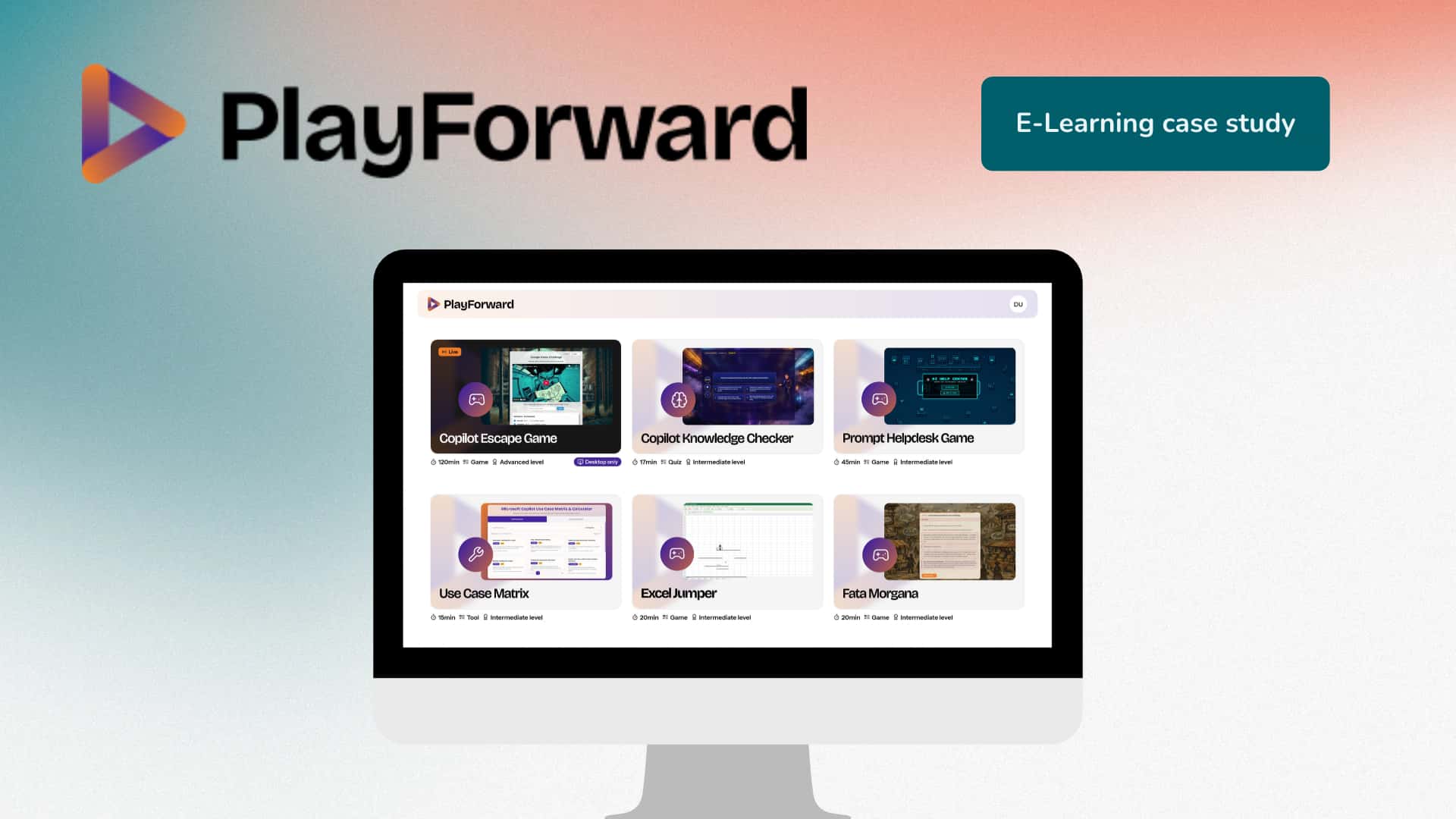
The client needed a customisable e-learning platform for educational games intended as AI & IT corporate training resources for their end clients.
Rather than providing courses and lectures to employees, their enterprise clients buy access to the platform with different types of games – e.g. escape rooms, quizzes, etc. – each of them focusing on teaching a specific business-relevant skill.
The client had already developed a functional proof of concept with the help of AI, and partnered with us to transform it into a fully-fledged scalable platform.
Additionally, this PoC had already been sold to an end customer, meaning that our client had already committed to a strict launch date – as well as set expectations – before development even started, putting us on a tight deadline.
Namely, our engagement began at the end of January 2026, and we finished the MVP build in late April, giving us a 3-month window for MVP development. Because of this, we decided together with the client to move fast and prioritise essential features, moving development of nice-to-haves into the post-launch phase.
Tech stack & details
The development was split into two streams: a robust back end for admin users, and an engaging front end for the game experience. The two main technologies used were Laravel Filament for the back end and React for the front end.
Inertia.js was also used to build the React single-page app with a Laravel back end, primarily as an experiment to see how it fits our development workflows. It helped us avoid writing glue code and managing REST APIs. So, it was a “full” full-stack experience from the development point of view.
The SPA was prioritised to avoid full page reloads in order to provide an engaging and visually interesting experience to users, with a simple and clean yet playful UI/UX.
Filament was used to build an intentionally simple and modular back end admin experience. Architecture was designed with multi-tenancy and scalability as top priorities, meaning that no structural rework would be required for onboarding new tenants (customers). The admin dashboard is feature-rich, intuitive and performant, providing a seamless experience for all users.
The chosen architectural approach ensures that the client avoids costly refactors as their customer base scales, and that scaling logic doesn't add unnecessary complexity to admin operations.
Finally, Microsoft Azure was used to implement single sign-on (SSO) which was a requirement from the end clients for handling authentication.
Since we are familiar with the typical complexity and edge cases of Microsoft identity integrations such as license updates, this was handled as a known risk area early on in the development process. It turned out to be the most time consuming part of the project, taking up almost 40% of development.
Another important requirement from day one was multilingual support, i.e. support for both interface-level translation and content-level localisation. We also added a translator role for native speaker review of AI generated content to make sure the texts are clear to local audiences.
This positions the platform for future expansions into new markets, where both the platform and games will need to be localised.
Post-launch work
As mentioned earlier, the MVP phase of development focused on building on the architectural robustness of the platform, prioritising key features, to allow for future scalability. To keep scope in control, we assembled a strict MVP/post-MVP review jury consisting of project managers, developers and client team members to ensure the team focused on these functional priorities.
This meant that after launch, we still had a full backlog of features to develop, which we have been working on since. This work is done as iterative refinement, with monthly front-end updates driven by real usage and client feedback rather than a one-off delivery. It focuses primarily on UI/UX optimisation and further development of administrative features.
In addition, the client is planning to expand the platform into new markets in autumn, so we are in the process of preparing the localisation push for this expansion. The elegant admin experience also supports consistent creation and release of new games available on the platform.
Reflections & closing thoughts
Despite the tight deadline, the collaboration with the client’s team was exceptionally seamless and enjoyable. Their team lead shares this sentiment about working with us:
“I love working with partners who think beyond code and genuinely contribute to the success of our product. Agiledrop has consistently done exactly that. Their team combines technical expertise with strong collaboration, responsiveness, and a clear focus on delivering value. They have become a trusted extension of our team and have played an essential role in the launch of PlayForward. And they're fun too!”
– Rhé, Lead Learning Products at Xylos
The client’s team was full of ideas, but equally receptive to our perspectives and our engineering approach. One of the hardest parts throughout the development, particularly during the MVP phase, was calibrating scope to fit the available budget and time, since the ideas just kept coming and the whole team really enjoyed building the product.
Laravel Filament has once again proved itself as a particularly fitting tool for the purposes of e-learning experiences, enabling easy and intuitive management. We already put Filament to great use when we built MooPanel, the open source management tool for Moodle, as part of our development of a customised Moodle solution for the University of Ljubljana.
If you’re looking for a reliable development partner for your e-learning or EdTech product, learn more about our work in e-learning, and feel free to reach out to us directly for specific inquiries and requests.